By Fareed Tulbah, owner of Caden Roofing · 8,000+ roofs inspected · Last updated November 1, 2026
8.0
top IBHS hail score, shared by a Class 3 shingle
Source: IBHS ratings, 2026
4 of 27
impact-resistant shingles rated Marginal by IBHS
Source: IBHS ratings, 2026
0
shingles rated Excellent against lab-made hail
Source: IBHS ratings, 2026
No set %
Texas premium discount; each insurer sets its own
Source: Texas Department of Insurance
Quick Answer
Class 4 shingles are worth it when your home sits in an area that sees damaging hail, you’ll stay long enough for your insurance premium discount to pay back the upgrade, and the exact shingle you buy scores well on real-hail testing. If you’re selling in a few years, or your area rarely sees hail, the upgrade usually doesn’t make financial sense.
The Class 4 label alone is not enough. In independent testing with lab-made hailstones, a Class 3 shingle shares the top score, and several impact-rated shingles rate Marginal.
What does Class 4 mean on a shingle?
Class 4 is the top rating in UL 2218, a lab test run on brand-new shingles:
- Shingles are installed on a test deck, eight courses high.
- A 2-inch steel ball (about 1.15 lb) is dropped from 20 feet.
- Six spots are picked where the shingle looks weakest. Each spot is hit twice in the same place.
- The deck is taken apart and the back of each shingle is checked for cracks, often under magnification.
- No crack through the back means it passes.
| Class | Steel ball | Drop height |
|---|---|---|
| 1 | 1.25 in | 12 ft |
| 2 | 1.50 in | 15 ft |
| 3 | 1.75 in | 17 ft |
| 4 | 2.00 in | 20 ft |
What the test doesn’t count: dents, bruising, and granule loss on the top of the shingle. Those are exactly what an adjuster looks at after a storm. The test also uses new shingles, not ones that have baked in Texas sun for ten years.
Is a 2-inch steel ball the same as 2-inch hail?
No. A steel ball is far heavier than a hailstone of the same size, so it’s dropped slower to reach the same energy. Engineers call UL 2218 an indexing test: it ranks products against each other but doesn’t reproduce real hail physics.
Some shingles are tested to FM 4473 instead, which fires ice balls. The Insurance Institute for Business & Home Safety (IBHS) built its own hail test because neither one predicts real storm damage well enough.
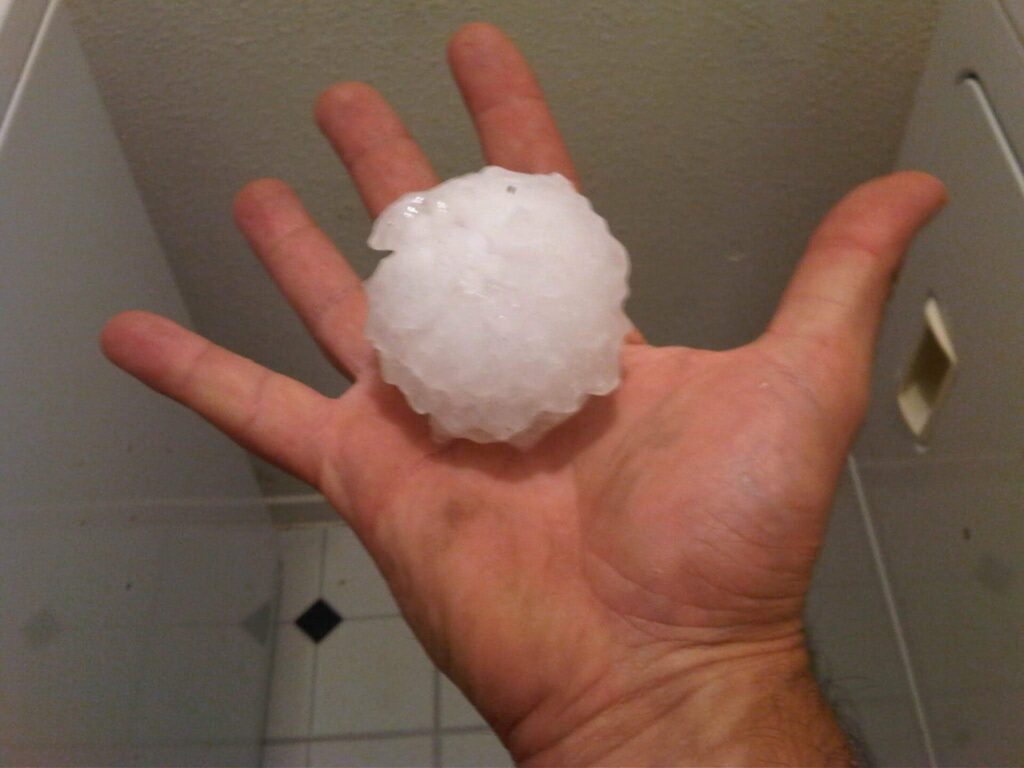
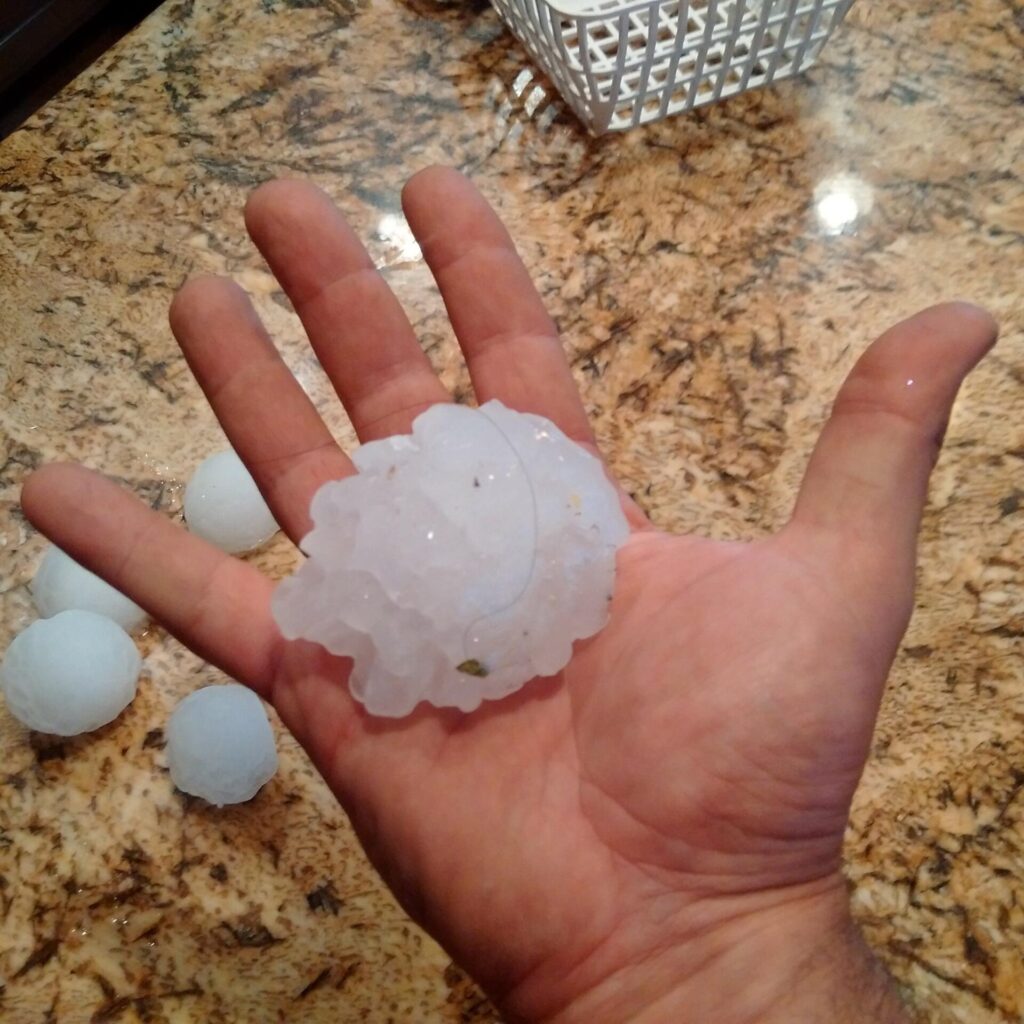
Hail isn’t shaped like the test ball either. Real hailstones are rarely smooth and round. They’re often lumpy or spiky, like these two.
What do manufacturers add to make a shingle Class 4?
Three methods, alone or combined:
- Rubberized asphalt (SBS). A rubber-like polymer, often 2–6% of the coating, makes the shingle bend instead of crack.
- A fabric backing. A polymer mesh on the back holds the shingle together so cracks can’t open through.
- A heavier mat. More fiberglass and asphalt mass absorbs the hit.
Each method helps pass the steel-ball test differently. That’s why shingles with the same Class 4 label score so differently against real hail.
Which shingles actually hold up to hail?
IBHS buys shingles off retail shelves and fires lab-made hailstones at them. It scores each product from 0 to 10 for dents, tears, and granule loss. IBHS doesn’t recommend Marginal or Poor products where hail is common.
| Shingle | Maker | IBHS score | Rating |
|---|---|---|---|
| TruDefinition Duration (UL Class 3) | Owens Corning | 8.0 | Good |
| Grand Sequoia Lifetime Designer | GAF | 8.0 | Good |
| Timberline AS II ArmorShield | GAF | 7.9 | Good |
| Legacy Scotchgard Protector | Malarkey | 7.8 | Good |
| Belmont IR | CertainTeed | 7.7 | Good |
| NorthGate ClimateFlex | CertainTeed | 7.7 | Good |
| TruDefinition Duration FLEX | Owens Corning | 7.5 | Good |
| HailGuard | TAMKO | 7.4 | Good |
| Highlander AR | Malarkey | 7.0 | Good |
| Presidential Shake IR | CertainTeed | 6.9 | Good |
| Landmark | CertainTeed | 6.9 | Good |
| TruDefinition Duration STORM | Owens Corning | 6.9 | Good |
| Vista AR | Malarkey | 6.8 | Good |
| StormMaster Shake | Atlas | 6.8 | Good |
| Timberline HDZ | GAF | 6.7 | Good |
| Pinnacle Impact | Atlas | 6.6 | Good |
| Grand Sequoia AS | GAF | 6.5 | Good |
| Pinnacle Sun | Atlas | 6.4 | Good |
| PABCO Prestige | PABCO | 6.2 | Good |
| Landmark ClimateFlex | CertainTeed | 6.2 | Good |
| Timberline UHDZ | GAF | 6.1 | Good |
| Pinnacle Pristine | Atlas | 6.0 | Good |
| Timberline UHDZ with UltraMat | GAF | 6.0 | Good |
| StormFighter FLEX 4 | TAMKO | 5.8 | Marginal |
| Dynasty with ArmourZone | IKO | 5.7 | Marginal |
| Nordic with ArmourZone | IKO | 5.6 | Marginal |
| Titan XT | TAMKO | 5.4 | Marginal |
What the table tells you: the class on the wrapper doesn’t predict the hail score. Ask for the exact product name on your quote and look it up.
Is a Class 4 roof hail-proof?
No. Owens Corning’s own spec sheet says a class rating doesn’t guarantee a shingle will withstand hail, and its shingles aren’t warrantied for hail damage.
Caden Roofing installed a Class 4 GAF Timberline AS II ArmorShield roof on an Austin home, one of the top-scoring shingles on the IBHS list. The next year, a storm dropped hail big enough to break through a skylight and land in the living room. That roof had to be replaced.
Class 4 lowers the odds of damage from moderate hail. Hail bigger than the test ball can still total a roof.
Does roof age matter more than class?
For small hail, often yes. Across more than 8,000 roof inspections, Caden Roofing has seen shingles with no impact rating start taking damage from roughly 1.25-inch hail when new, but from about 0.75-inch hail by year 16. An aging roof is more exposed than its label suggests.
Hail size (inches) by roof age (years)
More on how roof age changes a hail claim: Should I file an insurance claim for hail damage?
How much is the Class 4 insurance premium discount in Texas?
Texas law sets no fixed percentage. The Texas Department of Insurance says each insurer sets its own premium discount, company by company, and Class 4 gets the highest discount that insurer offers. Some insurers give Class 3 the same discount as Class 4; others give it less or nothing. It depends on the insurer. Any website quoting a single Texas percentage is guessing.
Ask your agent four questions:
- Do you give a premium discount for Class 3, Class 4, or both, and is it the same amount?
- How much is it in dollars per year on my policy?
- Does taking it add a cosmetic damage exclusion or change my deductible?
- What paperwork do you need?
Does the premium discount come with a cosmetic damage exclusion?
It can. About 57% of Texas homeowners policy filings carry a cosmetic exclusion, often tied to the impact-resistant premium discount. If hail dents or scuffs your roof without causing leaks, you may not be covered. Read the full guide to cosmetic damage waivers.
How much more does Class 4 cost?
In Caden Roofing’s experience, upgrading to a Class 4 shingle typically adds $50–80 per square (100 square feet) compared with a standard laminate architectural shingle that has no impact rating. On a typical 30-square Austin roof, that’s about $1,500–$2,400.
Payback math:
- Upgrade cost ÷ yearly premium discount in dollars = years to pay back
- Example: $2,000 ÷ $300 a year ≈ 7 years
If you’ll stay longer than that, the upgrade pays for itself. If not, it usually doesn’t.
Class 3 vs. Class 4: which should you choose?
| Class 3 | Class 4 | |
|---|---|---|
| UL 2218 test ball | 1.75 in | 2.00 in |
| Premium discount | Depends on the insurer; sometimes the same as Class 4 | The insurer’s highest (TDI) |
| Top IBHS score | 8.0 | 7.9 |
| Cost | Lower | +$50–80 per square vs. a non-rated architectural shingle |
Choose on the IBHS score and your insurer’s premium discount, not the class alone.
How do you prove you have an impact-resistant roof?
With TDI Form PC068, the Impact-Resistant Roofing Installation Form. Caden Roofing fills it out after the install, and you send it to your insurer.
How to choose a shingle for hail
- Check how often damaging hail hits your area. Your insurer, neighbors’ recent claims, and your own roof’s history are good guides.
- Decide how long you’ll stay in the home.
- Get your insurer’s premium discount in dollars for Class 3 and Class 4.
- Ask whether the discount comes with a cosmetic exclusion.
- Get the exact product name on every quote.
- Look up its IBHS score and skip anything rated Marginal or Poor.
- Do the payback math.
Weighing Class 4 for your roof?
Caden Roofing prices standard and impact-rated options side by side, so you can see your real numbers and decide for yourself.
Call (512) 364-0278, email [email protected], or request an inspection online.
Frequently asked questions
Are Class 4 shingles worth it if I’m selling soon?
Usually not. The premium discount needs years to cover the upgrade cost.
Do Class 4 shingles look different?
No. From the street they look like regular architectural shingles.
Can a Class 4 shingle still get hail damage?
Yes. The test stops at a 2-inch steel ball, and real storms can bring bigger hail.
Is the highest-rated hail shingle a Class 4?
Not necessarily. IBHS’s top score, 8.0, is shared by a Class 3 shingle, Owens Corning Duration, and a GAF designer shingle.
Do I get the discount automatically?
No. Your insurer needs proof, usually TDI Form PC068.
Related reading
- Should I file an insurance claim for hail damage on my roof?
- What is a cosmetic damage waiver on your roof?
- FORTIFIED roof in Austin: what it is and what it costs
- Hail damage restoration
- All roofing guides
Sources
- IBHS, Hail Impact-Resistant Shingle Ratings (2025 and 2026)
- IBHS, Relative Impact Resistance of Asphalt Shingles (UL 2218 pass criteria)
- UL Solutions, UL 2218 certification and the UL–IBHS shingle program
- IIBEC, Testing of Impact-Resistant Asphalt Shingles
- ASCE Natural Hazards Review, impact energies in UL 2218 and FM 4473
- Texas Department of Insurance, Products qualifying for impact-resistant roofing credits
- Texas Department of Insurance, Form PC068
- Owens Corning, TruDefinition Duration STORM specifications
- Owens Corning, Class 4 impact-resistant roofing shingles